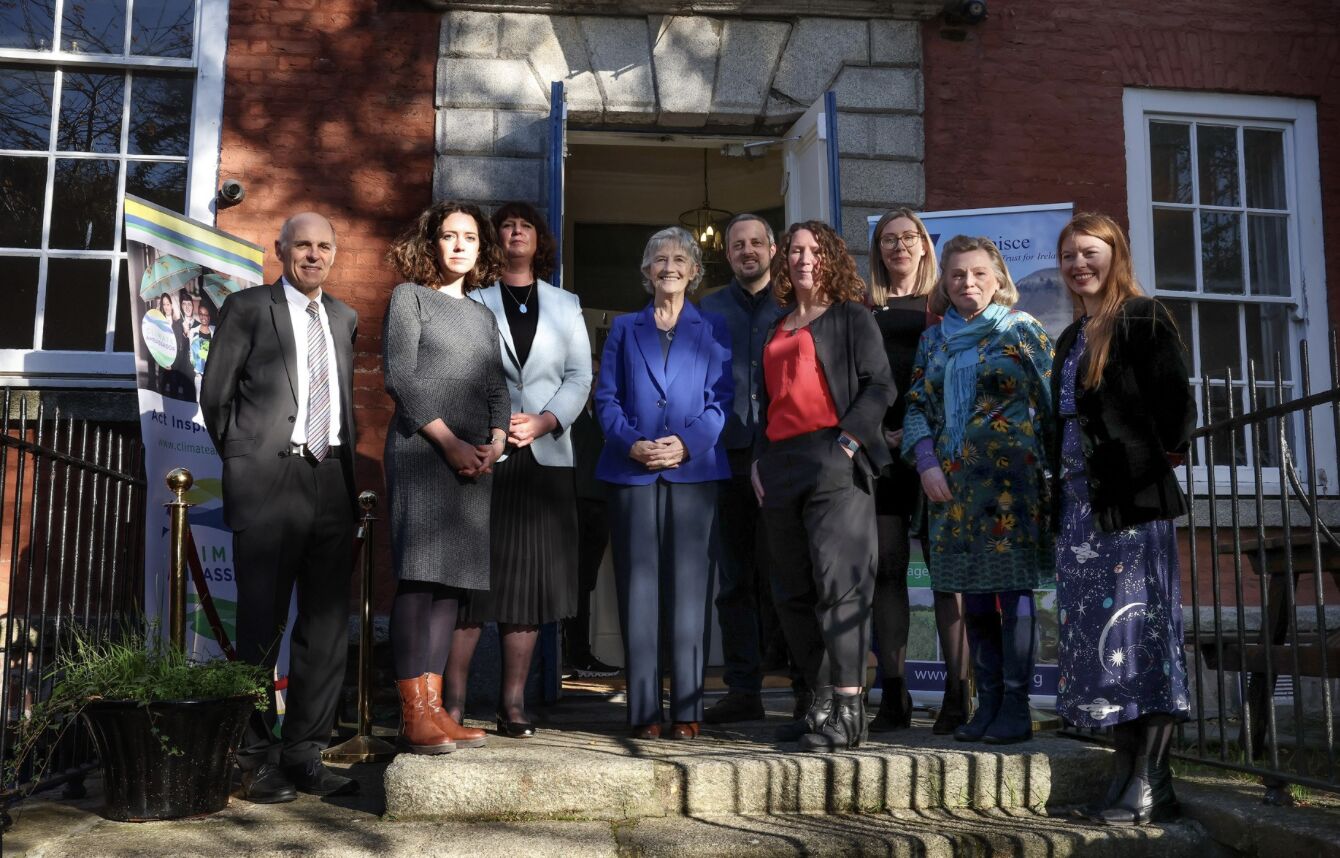
I was deeply honoured to be chosen by An Taisce as an expert speaker on climate change, presenting to Uachtarán na hÉireann Catherine Connolly at ‘Snapshots on Climate Change and its impacts on our Welfare’. Below are my speaking notes from this wonderful and heartening event on 19 November 2025.
‘Let the Land Speak’: cultural heritage, climate and just transition
Comhghairdeas ó chroí leat a Uachtaráin ar do toghcháin stairiúil, croíúil. Is aoibheann an tócáid a bhí ann, don tír, don Ghaeilge agus don comhshaol. Is ábhar dóchas é freisin gur labhair tú i do chéad oráid mar Uachtaráin faoin cheangailt idir ár dteanga agus an mórshaol – ár thaisce: “teanga ina bhfuil spiorad ár sinsear agus nádúr ár dtíre le mothú i chuile focal, sa dara háit, gan meas nó ómós tugtha di.” Bhí sé go hálainn an meon sin a chloisteáil, gan leithscéal gan ceansú.
Mar a duirt tú ar maidin linn comh maith, “is chuid den réiteacht ar athrú aeráide an teanga…mar níl an bhearna céanna idir an duine agus an dúlra”.
Insan meon seo, tá d’oibre cheangailte le feachtas atá ar siúil ar feadh na céadta blian anuas, ó tús an coilíneachas. Go bhfuil ár n-oidhreacht, ár gcultúr agus an comhluadar atá againn már daoine leis an mórshaol/comhshaol, gur cheist geilleagrach é seo. That the way that we speak about and see nature, relate to it and each other, is not something that is to be cut off from economic questions of how to manage our society and economy. Cultural heritage, language and ways of relating to nature, are not separate to our economy. Sovereignty once meant that we have a right in concert with other decolonising countries to structure our use of natural resources, even the extractive idea of “natural resources” in a way that is different from the imperial or colonial core. The question of how to see nature, how to treat “resources” is central to how we might direct our nation’s wealth. The Irish language guides us in reorienting our notions of value, what we the people value, not what profit or certain powerful people might value.
This other way of seeing what our economy values is a cultural right, a question of heritage, history and sovereignty as a people. The Irish language is central as it allows us to develop and value other ways of seeing the world, valuing it beyond “natural capital.”
I feel my heart break when I see a new book on the Irish seashore or the Irish environment that omits the words that these features are known by in the Irish spoken language. Maddeningly, these books quote instead a latin term. Crucially, not the latin or greek of the ancients, but a scientific language of standardisation developed in the early modern era as it ‘explored’ the ‘New World’. These latin terms were developed specifically to render all similar forms in nature the same, removed from their cultural and social context, so they could be more easily exploited and extracted. The language used by ‘natives’ was too burdened, even savage.
Yet, alternative understandings of energy and nature are still powerful. When we think of the word ‘fuinneamh’, for example, we do not think of extraction or profit as energy law or energy markets require, we think of vitality, life, vibrancy, vigour, spirit. “Duine bríomhar, aá a lán fuinneamh aige”, I think of TG4’s Hector, a national treasure/taisce himself! Energy can be revitalised, thought anew, connected to older ideas of freedom, vitality, strength in togetherness; such as fuinneamh or neart in the Irish language.
I brought with me today a book by the late, great Manchán Magan, ‘Let the Land Speak’. What would it mean if we chose another way of organising our economy, if we followed our language when it came to climate action and international solidarity? If energy is spirit, what is the spirit of the land that ultimately provides its roots and origins? What is best for the spirit, the vitality of the people? Could we build a new economy that allows the land to speak, that leaves no one behind, that acknowledges the harm done to other places from which we’ve taken oil or coal or wealth without reparations or care?
From this I would like to highlight the need to retain the original meaning of ‘climate justice’, a legal term that recognises that emissions reductions are paramount, in a context of “common but differentiated responsibilities”. That is, that we must “Keep 1.5 Alive” and the wealthy in the Global North take on the burden of fast, just climate action. Climate justice is fundamentally about human rights, and we must guard against the term being watered down and broadened out – a harm I see being done to the principle of just transition.
From this I have four key pointers as we set out ahead:
- The importance of material benefit to the worst affected, from workers in the Midlands, to Travellers, the elderly and single parent families in energy poverty
- The importance of legal frameworks of accountability and human rights, the need to protect our international democracy and multi-lateral systems.
- The importance of valuing pluralism as a sovereign question, as Peter Doran has pointed out. That culture, heritage and histories hold within them ways of economic seeing that will get us out of this crisis.
 Sinéad Mercier
Leave a comment